

Soapstones are a group of natural stones which, alongside various other minerals, contain talc as their main constituent. Every type of soapstone consists of a considerable proportion of talc. The talc content of Finnish and Brazilian soapstone, for example, is around 50% and can locally rise to 80–90%, in which case it is referred to as steatite or simply pure talc. Talc is a relatively common mineral with the formula Mg3Si4O10(OH)2. It forms through the alteration of older minerals by aqueous solutions. The deformation of rock masses during mountain building allows these solutions to penetrate the rock and thus convert the original minerals into talc.
All soapstones are metamorphic rocks that formed from older rocks under relatively high pressures and temperatures. These parent rocks originate from the Earth’s mantle, where the proportion of silicon is considerably lower than in the typical rocks of the Earth’s crust. Instead of silicon, these rocks contain more magnesium and iron. Among other things, this accounts for the relatively high specific weight of soapstone of almost 3,000 kg per m³. Which type of soapstone is present therefore depends both on the composition of the parent rock and on the pressure and temperature ranges it has passed through.
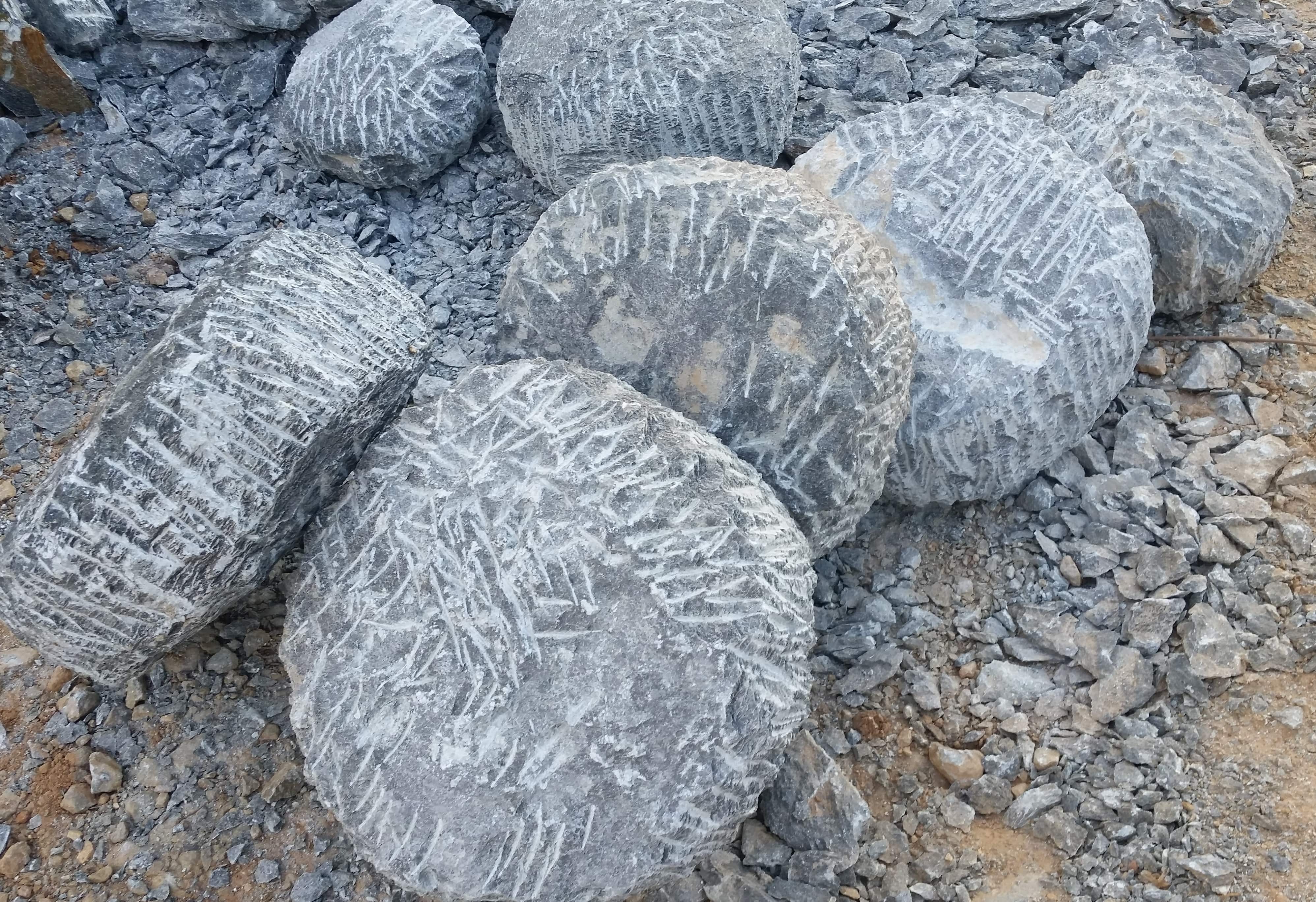

Despite their different compositions and properties, these various rocks are collectively referred to as soapstones. The only feature common to all types of soapstone is their high proportion of talc, which makes them relatively easy to work. Other properties, such as heat resistance and heat storage capacity, but also colour and grain, depend for example on the magnesium content and can vary considerably. However, not all rocks referred to as soapstone actually have the properties commonly attributed to “soapstone”.
This applies in particular to completely different rocks such as serpentinites and serpentine schists, which may resemble soapstone in colour and texture but contain little or no talc and magnesite or dolomite. Without these minerals, thermal properties such as heat storage capacity and thermal conductivity are of course entirely different. Serpentinites take their name from the serpentine minerals, including chrysotile, lizardite and antigorite, which can make up to 90% of serpentinites. The dense green serpentinites from the Valmalenco in the Italian Alps, for example, consist of 80–90% antigorite and contain almost no talc.
In 1812, the geologist F. Mohs developed the scale of mineral hardness named after him. All soapstones are characterised by a low hardness value on this scale. This is due above all to the high proportion of talc, which has the lowest hardness of all minerals on the Mohs scale (H = 1). In addition, the magnesium-rich carbonate mineral (i.e. magnesite and/or dolomite) in particular influences the hardness of soapstone. Both magnesite and dolomite have a hardness of around 4 on the Mohs scale. Marble and limestone usually consist of calcite, which has a slightly lower hardness of 3. Granites, on the other hand, range between 6 and 7 on the scale and are therefore considerably harder.
| Hardness | Reference mineral |
|---|---|
| 1 | Talc |
| 2 | Gypsum |
| 3 | Calcite |
| 4 | Fluorite |
| 5 | Apatite |
| 6 | Feldspar |
| 7 | Quartz |
| 8 | Topaz |
| 9 | Corundum |
| 10 | Diamond |
It is this low hardness that distinguishes every soapstone and gives it its excellent workability. Only soapstone can really be worked well with the simplest hand tools, which is why people have used it for a wide variety of purposes since the Stone Age. The oldest Norwegian soapstone artefacts, for example, are small animal and bird sculptures from the Stone Age. Low hardness and good workability do not mean, however, that soapstone cannot be used as a building material. On the contrary: in the early Middle Ages, churches were even built entirely or partly of soapstone. The best example is Nidaros Cathedral in Trondheim, whose construction began in 1070 and which is today regarded as Norway’s national sanctuary. That these buildings have withstood the weather for more than 1,000 years is due, among other properties, above all to the density of soapstone.
Its low hardness makes it easy to overlook the high density of soapstone. The specific weight of soapstone is around 3,000 kg per cubic metre. Only a few iron-rich rocks have higher densities. Ordinary granite is around 2,600 kg/m³, and sandstone, at about 2,000 kg/m³, is even lower.
The density of a rock is primarily determined by the density of its individual minerals. The two predominant minerals in soapstone have densities of 3,100 kg/m³ (magnesite) and 2,700 kg/m³ (talc). Antigorite, of which the serpentinites from the Valmalenco mainly consist, and quartz, which occurs in all ordinary hard rocks, have densities of about 2,650 kg/m³, for example.
This high density of the mineral components is due to the high pressures and temperatures under which soapstone developed from its older parent rocks. These extreme conditions of formation caused the atoms of the individual minerals to bond as closely as possible, while at the same time closing all cavities between individual crystals. All soapstones are therefore also characterised by very low porosity.
From the high density of soapstone it follows that soapstone cannot be very porous. And this is indeed the case. Soapstone usually has a porosity of less than 0.15%. A rock porosity of more than 6% is considered very high. Ordinary granite has less than 1%, soapstone less than 0.15% visible porosity. Such low porosity means that the rock contains only very few, very small cavities into which moisture and chemical substances could penetrate and weaken its strength. Water penetrating into cavities is also the cause of frost damage in many natural stones. The high density of soapstone prevents moisture from penetrating and gives the rock its high weather resistance and resistance to chemicals. The water absorption of our soapstone is below 0.09%. The average water absorption of ordinary natural stones, at 0.4 to 1%, is considerably higher.
Heat resistance refers to a rock’s ability to withstand high temperatures. As a rule, the higher the melting point of a substance, the more heat-resistant it is. At temperatures above 800 °C, talc transforms into two other minerals (cristobalite and enstatite). Quartz melts at 1,713 °C. The melting point of magnesite, however, the main constituent of many soapstones, is an exceptional 2,165 °C. For comparison, glass melts at between about 1,300 and 1,700 °C. It is therefore thanks above all to the high proportion of magnesite or dolomite that soapstone can withstand even the highest temperatures in a stove.
A frequently mentioned issue in connection with soapstone is the question of asbestos and the health risks it causes.
Asbestos is the name given to various minerals when they occur in the form of fibres. In fibrous form, some of these minerals have outstanding chemical, thermal and mechanical properties, which is why they were widely used in the past for boards, cements and fabrics. By the 1980s, the number of asbestos-based products had risen to more than 3,000. Once the health hazards of inhaling asbestos fibres were recognised, asbestos was banned in the EU in 2005. The reason is that fibres enter the lungs when breathing, lodge there, cannot be expelled by the body and can then cause cancer.
Mineralogically, asbestos minerals are divided into two main groups:
These minerals belong to the groups of phyllosilicates and inosilicates and occur in their “normal” crystallographic form in many rocks worldwide without being classified as asbestos. Only where they occur as fibres are they referred to as asbestos.
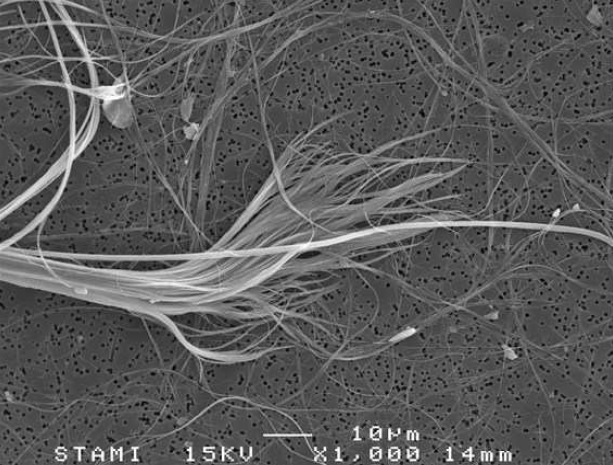
To determine whether a rock contains asbestos, it is therefore not enough to identify the minerals themselves. What matters is the crystallographic form of these minerals, which is determined by scanning electron microscopy (SEM). Only if fibres are detected in this examination is the material classified as asbestos. If the same minerals occur in compact, massive or platy form, there is no asbestos.
For years, our soapstones have therefore been examined regularly by officially recognised testing laboratories in Germany and abroad using scanning electron microscopy, confirming the non-fibrous form of the minerals.
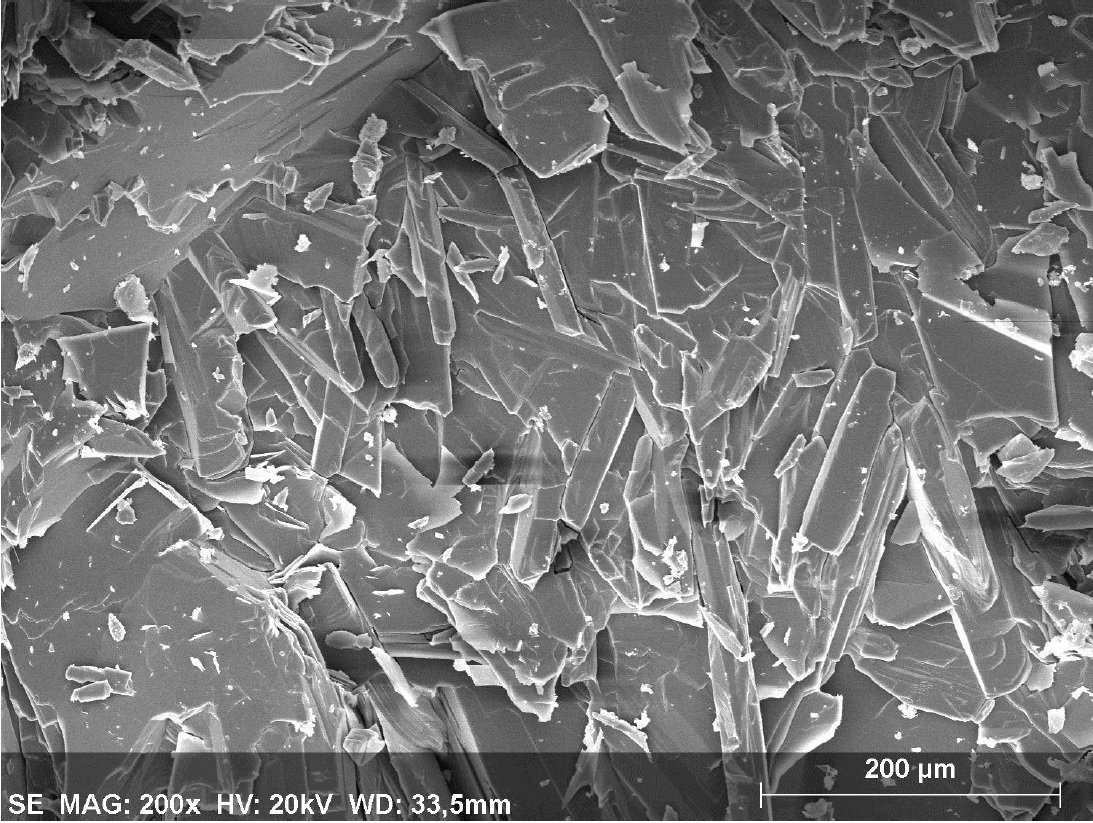
The most recent test report, KP 143/15 of 27 August 2015 by Prof. Dr. Klein of the Official Materials Testing Institute of Koblenz University of Applied Sciences, for example, concludes:
“According to the mineral phase analysis, the rock sample from ThermoStone, Weißenstadt, consists mainly of the mineral phases talc/soapstone, dolomite, tremolite and clinochlore. SEM analysis identified exclusively platy minerals. No fibres are evident, so it can be concluded that there is no asbestos in the rock of the sample examined.”
Official Materials Testing Institute, Koblenz University of Applied Sciences, test report KP 143/15 of 27 August 2015 (translated from German)
The soapstones we process are therefore proven to be free of asbestos. They can be used without any concern for stove claddings and in other applications as a natural stone.