

Our soapstone is extracted from three quarries near the town of Mariana in the state of Minas Gerais, Brazil.
Our soapstone is extracted from three quarries near the town of Mariana in the state of Minas Gerais, Brazil.


Geologically, the deposits therefore belong to the province of the São Francisco Craton. Cratons are the oldest parts of a continent, around which younger rocks have accumulated over the course of Earth’s history through a wide variety of geological processes. The rocks of the São Francisco Craton are between 3,400 and 2,000 million years old. For comparison: the first true fossil-forming organisms are about 600 million years old, the dinosaurs died out 65 million years ago, and the last volcanoes of the Eifel in Germany became extinct about 11,000 years ago. The soapstones of the São Francisco Craton are therefore among the oldest rocks on Earth.
The rocks in the region around Mariana are extremely diverse and unusual. They are former ocean basins whose floor consists of so-called mafic, i.e. dark-coloured, rock types such as basalt, gabbro, dunite and peridotite. Together with other rock types, these are grouped into the Mantiqueira and Isidro complexes. Today’s soapstone deposits formed in a few very special areas of these ocean crusts.
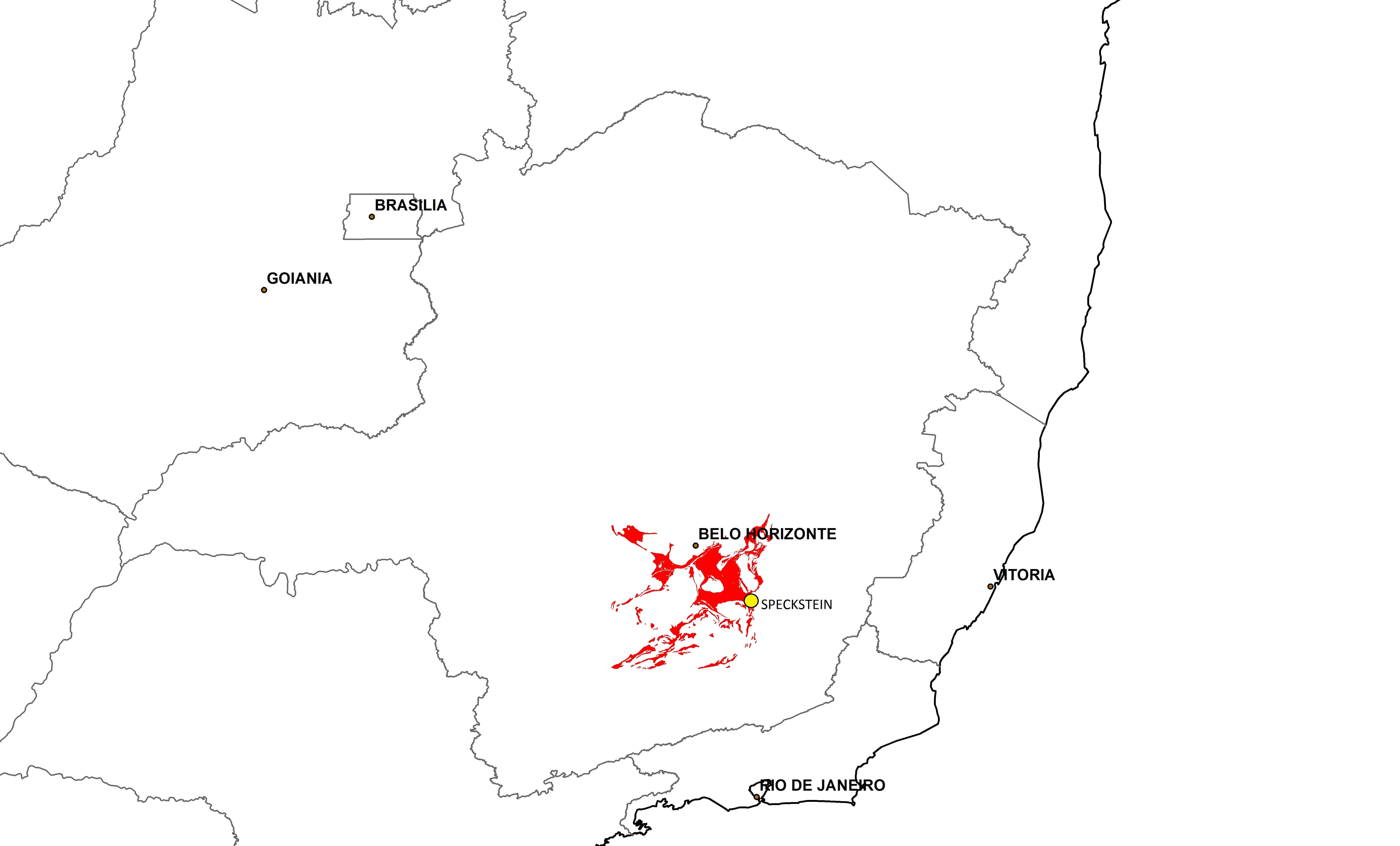
The ocean water deposited sands and clays on top of the ocean crusts at varying distances from the mainland. Today the sands are present as quartzites and the clays as schists. Sulphur-loving bacteria spread through these oceans, precipitated iron through complex chemical reactions and formed the unique Iron Quadrangle (Quadrilátero Ferrífero), one of the world’s most important deposits of banded iron formations (BIF). The quartzites, schists and iron ores are grouped together as the Rio das Velhas Supergroup.
Collisions of the São Francisco Craton with other continents caused these rocks to be displaced, tilted, melted and mixed. In the course of these movements, gold and gemstones formed – for which the Iron Quadrangle is world-famous – but so did talc and soapstone, from the previously unaltered dark parent rocks of the ocean crusts. Talc and talc-rich rocks such as soapstone formed in particular from magnesium-rich parent rocks that reacted with hot solutions. These hot solutions converted the minerals of the parent rocks into talc, chlorite and serpentine minerals.